

The stinger of the western honey bee (Apis mellifera) serves as a last-resort defense mechanism, designed to penetrate skin and inject venom — which frequently leads to the demise of the worker bee.
Recent studies published in the Proceedings of the National Academy of Sciences are literally illuminating the effectiveness of this defensive strategy.
“Capturing footage of them in action was an entirely new endeavor, made possible by advances in modern camera technology,” explained Fiorella Ramirez Esquivel, the lead author and postdoctoral researcher at Macquarie University in Australia.

Researchers documented how the stinger of a western honey bee penetrates a material while simultaneously delivering venom.
Due to the rapid nature of bee stings, Ramirez Esquivel and her colleagues utilized cameras capable of recording hundreds of frames per second. The transparency of the venom sac and stinger allowed them to employ bright lighting to highlight the unique structures within.
The experiments involved live honey bees, where their stingers were extracted and the bees were euthanized immediately afterwards. Since the stinger remains functional for only about two minutes once detached, Ramirez Esquivel noted the need for quick action.
“I remove the stinger from the bee and then must insert it into this artificial [skin substitute], and I only have about four millimeters of space to get it precisely right,” she shared with CBC News from Sydney.

At 100 frames per second, two distinct components can be seen within the middle chamber between the long needle and the large venom sac. These are valves that operate in a unique manner. (Ramirez Esquivel et al. 2026)
Double-piston mechanism
The findings reveal that two specialized valves perform dual functions: driving the barbed stinger deeper while simultaneously pumping venom from the sac into the flesh.
The research characterizes this as a “double piston design,” yet the mechanism is far more intricate than a typical car engine, where one piston moves vertically within a cylinder.
“Now picture having two pistons that must move past each other as they operate,” Ramirez Esquivel explained, “and when they switch directions, they need to retract so the fluid can flow around them.”
It’s a complex interaction that the researchers replicated using 3D printing, allowing them to delve deeper into how the valves navigate past one another — ensuring venom continues to flow while also driving the stinger deeper.
Juliana Rangel, an apiculture professor at Texas A&M University who did not participate in the research, expressed her fascination with the videos, noting that they provide insights beyond the scanning electron microscope images and diagrams she is accustomed to.
“We have long understood [the stinger and its components] because we have been stung for millennia,” Rangel stated. “However, the mechanics of how that venom continues to be pumped for an extended period after the stinger is deployed remained unclear.”
The study indicates that the stinger can continue to twitch and move for up to 15 minutes.
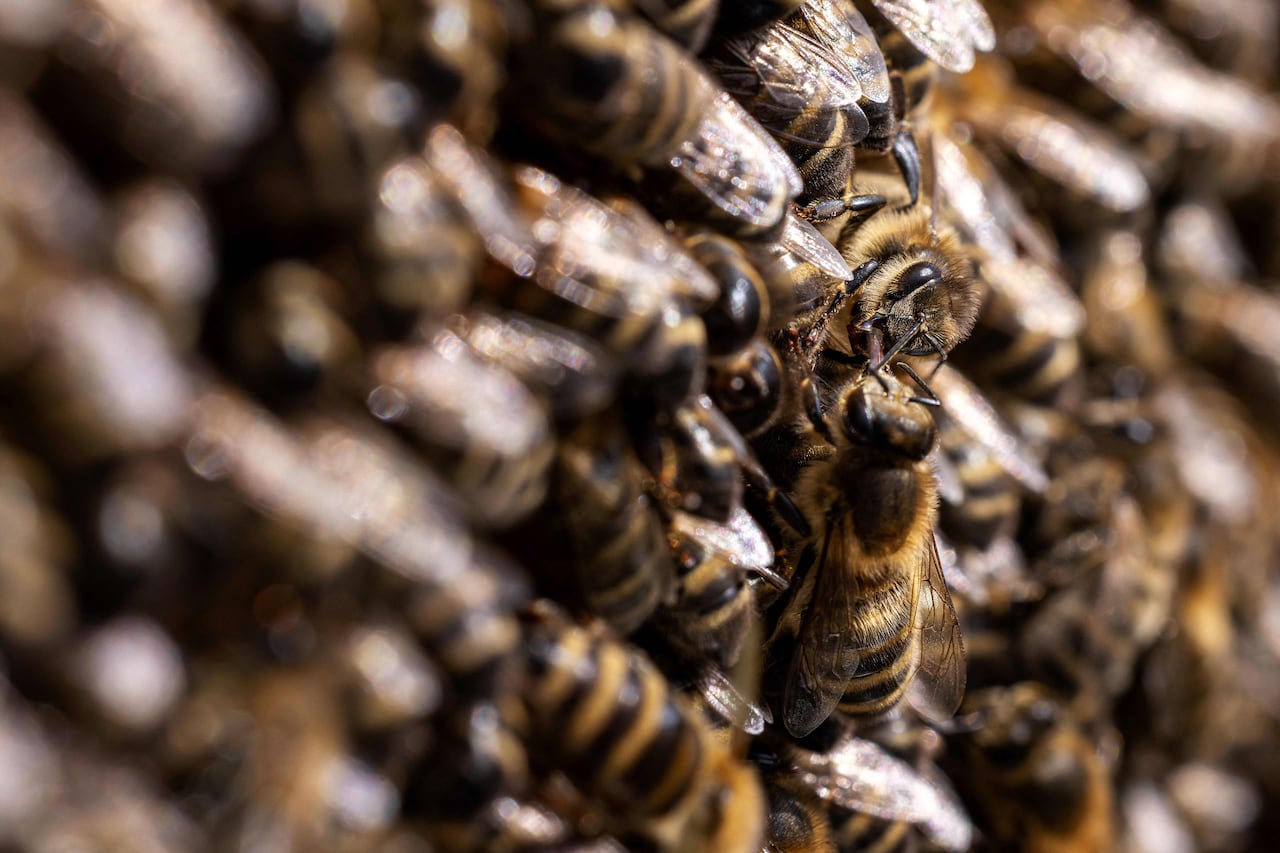
Honey bees are social insects, and experts assert that their stinging serves multiple purposes. (Joel Saget/AFP/Getty Images)
Kill and be killed
The act of leaving behind part of one’s body as a defensive tactic is termed autotomy, but not all bees exhibit this behavior. The western honey bee is a social species that operates as a “superorganism,” with workers dedicated to its protection. This extreme defense mechanism has to be more impactful than what one might expect from a small bee.
“This stinging structure and the evolution of the stinging apparatus… serves as a form of insurance,” Rangel remarked to CBC News from College Station, Texas. “It ensures that the sacrifice was made for a worthy cause, which is the defense of the larger colony.”
Rangel further mentioned that nearly all other stinging bees lack barbs that help retain the stinger in an attacker, as they, unlike female worker honey bees, need to survive to reproduce. Female worker honey bees are sterile and do not produce offspring.
Additionally, honey bee stingers release pheromones, which are chemical signals that summon other bees to assist in defending against a threat.
Rangel noted that this defense mechanism may not always be effective against tougher skin or fur, yet the barbs and continuous penetration likely enhance the likelihood of deterring an aggressor.

An illustration explaining the stinger from The Anatomy of the Honey Bee by Robert E. Snodgrass, published in 1910. (Cornell University Library/The Internet Archive)
Nature as a source of inspiration
Although originally from Europe, western honey bees are now present globally and have been the subject of study for centuries. Our connection with them spans even longer.
“This relationship dates back around 9,000 years,” stated Lauren Ponisio, an associate professor and ecologist at the University of Oregon. “Cave paintings depict people harvesting honey and wax from bee colonies. It wasn’t until the Egyptians that we see evidence of active management.”
Fast forward to 1758, when the Swedish biologist Carl Linnaeus formally classified the species. Their stingers, the study highlights, were thoroughly described by American entomologist Robert E. Snodgrass in the early 1900s.
By utilizing high-speed videography, researchers are uncovering more about this intricate system, with potential medical implications.
“It doesn’t stop and start like a … syringe. A syringe’s plunger moves down once, and that’s all,” Ramirez Esquivel explained. “However, because we have two plungers, there can be a continuous flow.”
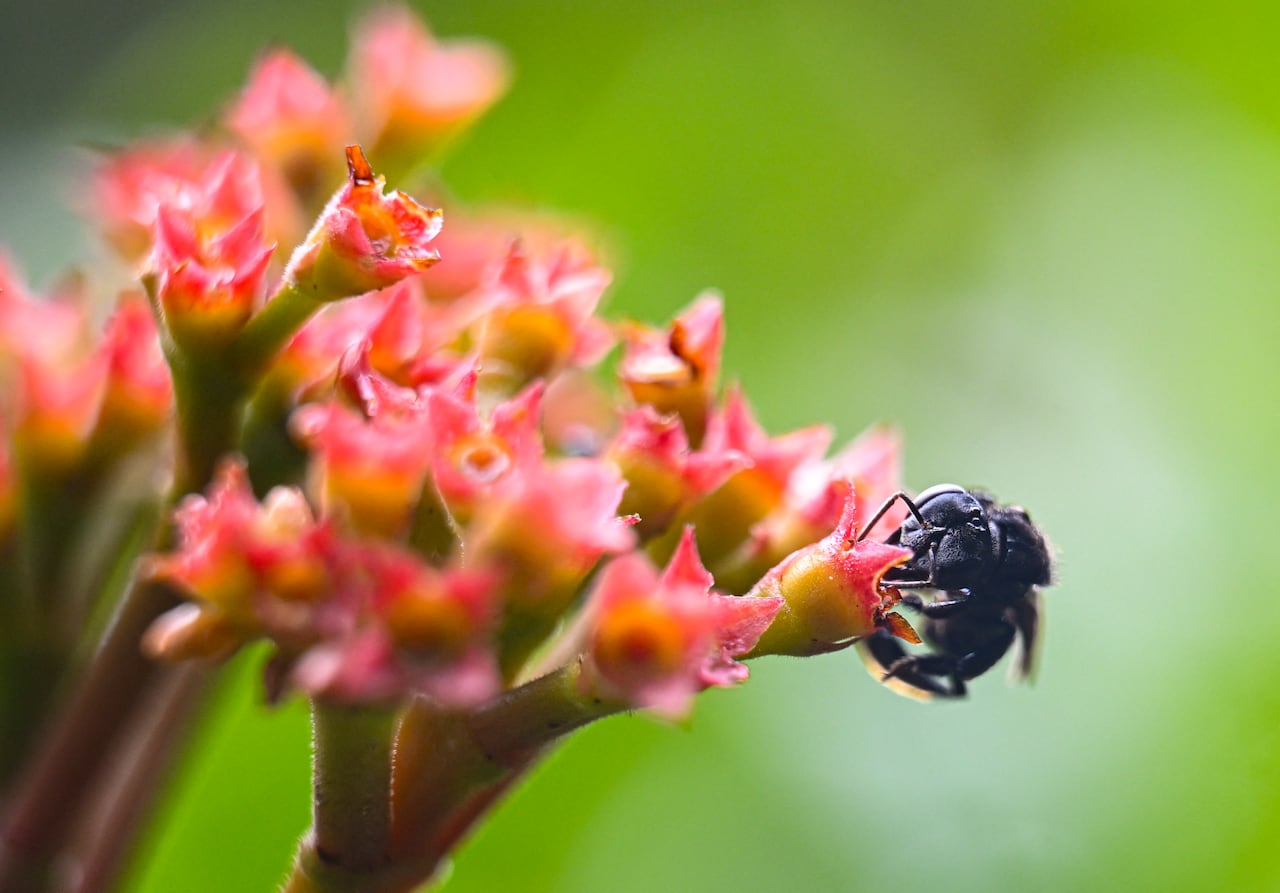
A black stingless bee (Trigona spinipes) is seen at the Metropolitan Natural Park, a protected area in Panama City on January 26, 2025. (Martin Bernetti/AFP/Getty)
Ponisio expressed that this research prompts her to consider other honey-producing bees that significantly differ from western honey bees, including those native to the Americas.
“It raises intriguing questions about these other honey-producing bees: why don’t they have stingers? How did that work out for them?” Ponisio pondered.

