

Researchers at the University of Alberta have made an astonishing discovery: a raptor dinosaur might have fed on a considerably larger tyrannosaur.
The team identified bite marks on the jaw of an Albertosaurus, which is a close relative of Tyrannosaurus rex—often referred to by researchers as its “teenage cousin”—that lived in Alberta around 70 million years ago.
The fossil belonged to an eight-year-old Albertosaurus, a sub-adult that had not yet reached its full size. The bite marks prompted researchers to consider two vastly different explanations regarding the events following the dinosaur’s death near Drumheller, Alta., located approximately 130 kilometers northeast of Calgary.
The most probable explanation, according to the researchers, is that a raptor—a smaller, bipedal, meat-eating dinosaur—consumed the larger Albertosaurus after it died under uncertain circumstances.
“This is one of those exceptional instances where we have evidence of a carnivore preying on another carnivore,” remarked Philip Currie, a professor of dinosaur paleobiology at the University of Alberta.
“It’s quite significant,” Currie added, emphasizing that Albertosaurus was among the leading predators of its era.
This finding could shed light on the interactions between carnivorous dinosaurs and the intricacies of the ancient food web.
Joshua Doyon, a master’s student in paleontology at the U of A, spearheaded the investigation into the bite marks.
By measuring the distance between the marks and comparing them with the teeth of other carnivorous dinosaurs from the same period, the researchers concluded that a raptor was the most likely culprit.
The alternative theory suggests that a much younger Albertosaurus, under two years old and around two meters long, could have cannibalized the larger dinosaur.
Discovery Leads to Research Project
The fossil was uncovered in 2022 by a member of the public who was canoeing in the badlands north of Drumheller. This discovery was reported to the Royal Tyrrell Museum, which collected the specimen and prepared it by clearing the surrounding rock from the bone.
As museum staff reconstructed the fossil, they observed the tooth marks, paving the way for Doyon’s research project in 2023.
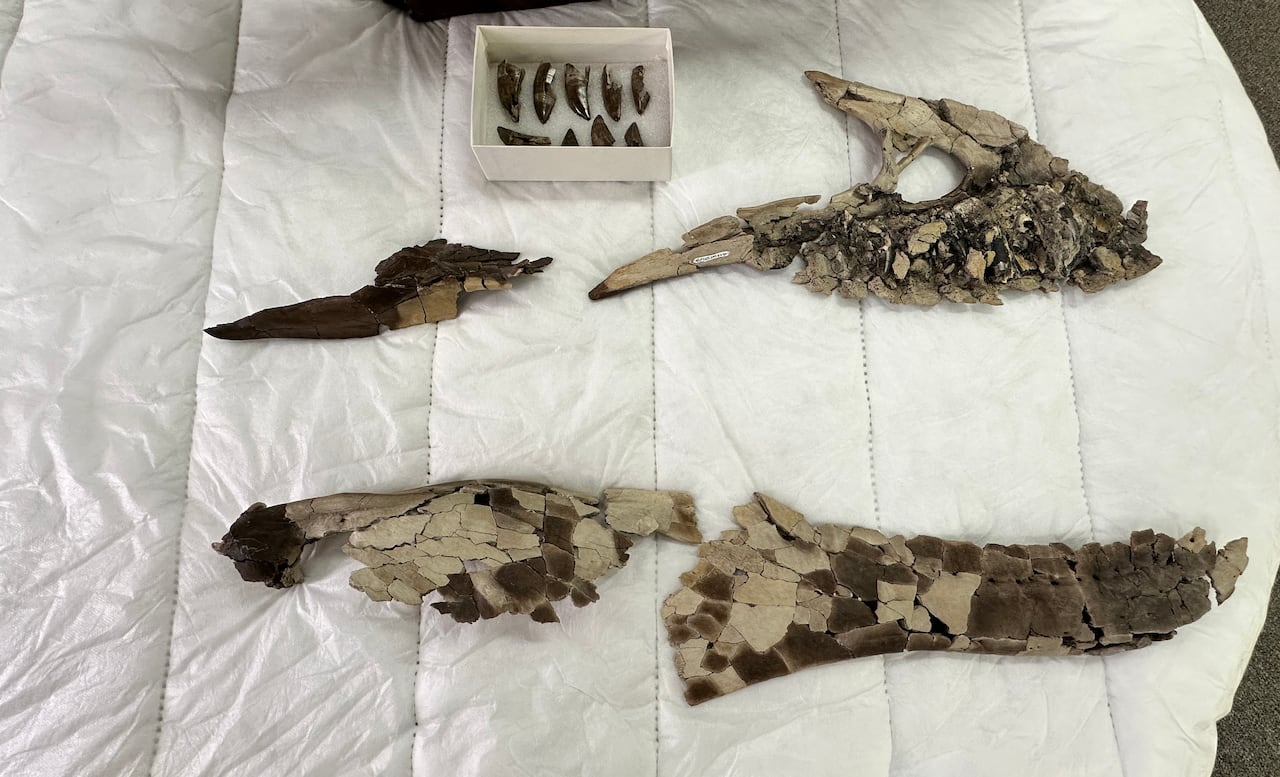
A closer view of the fossils that Doyan used in his research. (Scott Neufeld/CBC)
Doyon expressed his interest in examining dinosaur behavior and interspecies interactions when he approached museum researchers for potential projects.
The specimen provided a chance to explore a feeding interaction that occurred millions of years ago.
Currie noted that this discovery underscores how paleontologists can gain more insights into dinosaur biology by analyzing details within fossils, rather than just focusing on the identification and classification of the animals.
Details such as the tooth marks can enhance researchers’ understanding of which animals preyed on others and how species interacted within ancient ecosystems.
Albertosaurus was a top predator in its environment, while the suspected raptor would have been much smaller, roughly equivalent in size to a German shepherd, according to Currie.
This finding is notable as it provides rare evidence of one carnivorous dinosaur feeding on another instead of on herbivorous prey.
The term “raptor” may evoke images of the dinosaurs featured in the Jurassic Park films, but the species found in Alberta were smaller than their cinematic counterparts.
Doyon mentioned that the raptors that inhabited the area around Drumheller belonged to a group known as dromaeosaurs. The local species, Atrociraptor, measured about two meters in length and was significantly smaller than the dinosaurs depicted in films.
Doyon hopes that paleontologists and the public who discover dinosaur bones will pay closer attention to small tooth marks that might otherwise go unnoticed.

