

Tesla plans to cease Cybertruck production at its Gigafactory in Texas by mid-2027, according to CEO Elon Musk’s announcement on Friday. This decision follows several years of disappointing sales for the futuristic vehicle, which was once positioned as a competitor to traditional pickup trucks.
This shift represents a significant step back for one of Musk’s favored initiatives. In a post on X, Musk indicated that this decision would enable Tesla to focus more on the Cybercab, a robotaxi that is central to the company’s goals in the autonomous vehicle market, though it has not yet demonstrated commercial viability.
This announcement follows a challenging week for Musk, whose substantial political contributions, totaling nearly $500 million, resulted in minimal success during Tuesday’s U.S. midterm elections, with most of the Republican candidates he supported failing to win their contests.
Additionally, his companies were projected to experience a loss exceeding $180 billion in combined market value for the week.
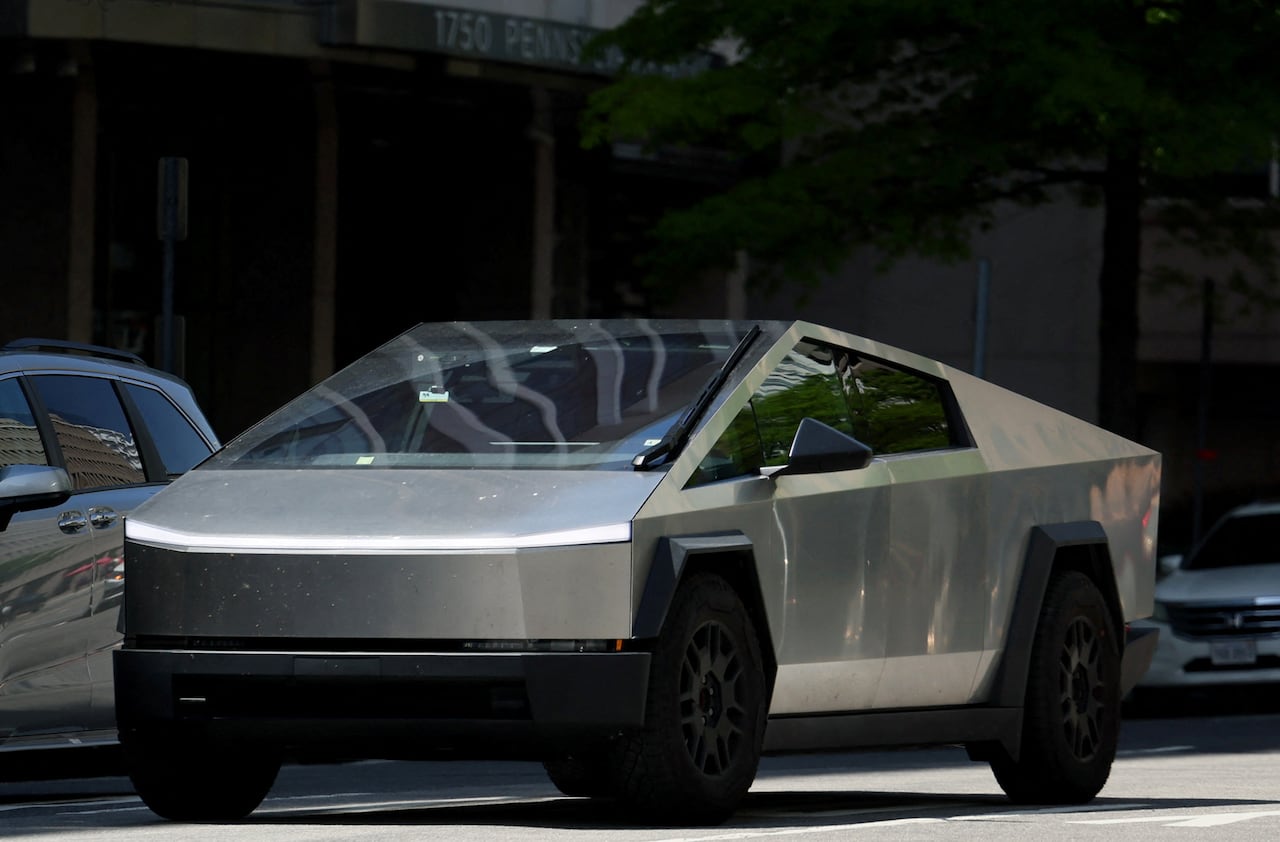
A Tesla Cybertruck near the White House last year. (Leah Millis/Reuters)
It remains unclear whether production of the Cybertruck will be relocated to another facility or completely discontinued, as the Austin plant is currently the only Tesla facility capable of producing the specialized parts required for the heavy, angular vehicle.
In a response to a post on X, Musk referred to the Cybertruck as the “best vehicle Tesla has ever made” and described the production winding down as the “end of an era.”
Tesla has been directing its efforts toward robotics and autonomous technology, which analysts believe may detract from the electric vehicle market that the company was instrumental in establishing, especially as competition from Chinese manufacturers intensifies.
The U.S. electric vehicle manufacturer began delivering the Cybertruck to customers in late 2023. Automotive analytics firm Kelley Blue Book reported that only 20,237 Cybertrucks were sold in the U.S. last year, a decline of 48% from the 38,965 sold in 2024. At the start of production in 2023, Musk had anticipated annual sales of 250,000 units.
“Continuing production when it is not achieving its targets does not make sense,” stated former Aston Martin CEO Andy Palmer. “Any logical automotive expert would agree.”
“While it may only be a minor detail on Tesla’s financials, the data is clear,” he added.
SpaceX, Musk’s aerospace company, was one of the largest purchasers of the Cybertruck last year, acquiring $131 million worth at the standard price, as per its IPO filing.
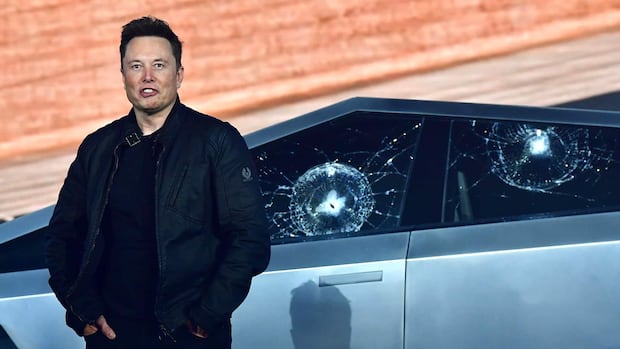
Tesla showcased its forthcoming entry into the electric truck market during an extravagant launch event last night. However, an attempt to demonstrate its “bulletproof” glass resulted in shattered windows due to a metal ball being thrown.
‘Cybertruck won’t go, can’t go’
Since its launch in 2019, the Cybertruck has been a contentious selection for Musk. Traditional pickup enthusiasts ridiculed its angular aesthetics, and safety analysts anticipated challenges in securing sales approval in major markets such as Europe.
The launch event itself faced issues when Musk attempted to demonstrate the windows’ shatter resistance by throwing metal balls at them, resulting in significant cracks in two of the windows.
During the Cybertruck’s official introduction in 2023, Musk promoted it as a forward-looking alternative to trucks from brands like General Motors and Ford, asserting, “At last, the future will appear as it should.”
Nevertheless, the vehicle has struggled to fulfill those predictions. Since its release in late 2023, Tesla has implemented 11 recalls for the Cybertruck, as reported by the National Highway Traffic Safety Administration. Some of the vehicles needed physical repairs, while others were rectified through over-the-air software updates.
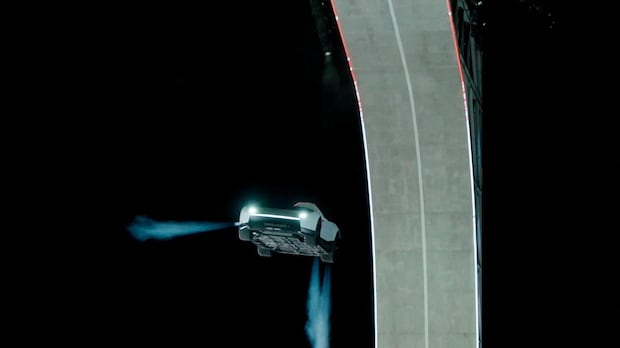
Elon Musk’s automotive company Tesla unveiled its second-generation Roadster, featuring cold gas thrusters and a “multi-mode” suction system that can launch the car into the air for brief periods and rotate it mid-flight.
While some analysts claim the Cybertruck is a failure due to its low sales numbers, Felipe Munoz, an automotive analyst, noted that electric pickups from Ford and other manufacturers have also struggled in the U.S. market.
“All of them have lost the contest because electric pickups are not well-received in the U.S.,” Munoz commented.
However, the Cybertruck’s sharply angular, stainless steel design has hindered its potential in markets such as Europe, where electric vehicles are more favored. Gaining regulatory approval in Europe proved impossible due to stringent rules regarding pedestrian safety.
“In any location where crash regulations consider pedestrian impact, the Cybertruck simply cannot succeed,” stated former Aston Martin CEO Palmer.

