

A man from Edmonton who is currently homeless is requesting a court to determine that the City of Edmonton is responsible for the confiscation and disposal of his personal items during an encampment cleanup conducted two years ago.
Dwayne Cardinal, aged 55, is pursuing a summary judgment in his legal case against the city, contending that the evidence shows city personnel unlawfully took his tent, tarps, sleeping bag, bicycle, stoves, clothing, and other possessions, ultimately sending them to a landfill.
The city contests this assertion, claiming its employees were authorized to remove the items under Alberta’s Municipal Government Act due to health and safety concerns.
The arguments were presented during a summary judgment hearing on August 18, a legal process that allows a court to settle a case without a full trial when adequate evidence exists.
Cardinal maintains that a trial would be financially burdensome for him.
Property Disposal
The key issue in this case revolves around Section 610(1) of the Municipal Government Act.
This section stipulates that lost or unclaimed property acquired by a municipality must generally be retained for at least 30 days. However, items can be disposed of sooner if they are deemed unsafe, unsanitary, or perishable.
Cardinal argues that this law does not apply to his situation, as his belongings were not lost or unclaimed.
He contends that he was in the midst of packing his items when he was detained by police, and not because he had abandoned or misplaced them.
Cardinal also asserts that city workers were aware the belongings were his and witnessed his detainment by the police nearby.
Conversely, the city argues that “lost” can refer to property that is simply out of the owner’s control. Given that Cardinal was arrested and removed from the location, his belongings were no longer under his possession.
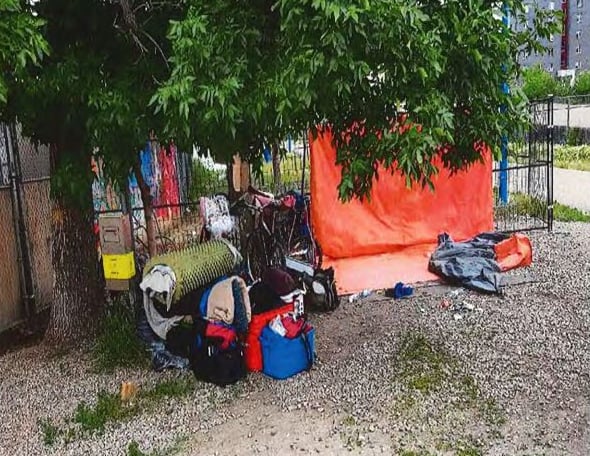
A photo taken by city workers of Dwayne Cardinal’s encampment located behind the Bissell Centre in downtown Edmonton. (Court exhibit)
The city further claims that the property was considered unclaimed from the perspective of its workers, who did not communicate directly with Cardinal and were informed by police that the area was ready for clearing.
The city argues that expecting workers to ascertain the reasons for every item being left behind would establish an impractical standard for municipal cleanup teams.
City Claims Belongings Were Unsafe
Cardinal also contends that the city did not demonstrate that his specific belongings were unsafe or unsanitary enough to warrant immediate disposal.
His attorney, Chris Wiebe, stated that city workers depended on a general cleanup protocol that assumed items at encampments were contaminated, rather than inspecting Cardinal’s individual possessions.
The city, however, states that the conditions at Cardinal’s encampment justified immediate disposal, with cleanup crews discovering used drug paraphernalia, including methamphetamine pipes and burnt tin foil, along with 48 needles at the site.
The city also referred to a police report noting another individual defecating near the tent and mentioned an ongoing Shigella outbreak affecting Edmonton’s unhoused population at that time.
Court documents from the city assert that materials from encampments can be contaminated, posing risks if stored and potentially exposing municipal workers and the public to cross-contamination.
Cardinal Asserts Seizure Violated His Rights
Cardinal is also claiming that the disposal of his belongings represented an unreasonable seizure under Section 8 of the Canadian Charter of Rights and Freedoms.
He states that he received no prior notice before the cleanup commenced and was actively packing his items when police detained him, during which time city workers removed and disposed of his possessions.
The city disputes the applicability of Section 8, arguing that the Charter provision safeguards reasonable expectations of privacy rather than guaranteeing an absolute right to property.
According to the city, Cardinal’s encampment was situated on a public, multi-use LRT pathway, making it visible to pedestrians and cyclists.
Even if Section 8 were applicable, the city contends that the seizure was legally authorized and performed to ensure public health and safety.
Cardinal is seeking $7,000 from the city: $1,000 for the worth of his belongings, $1,000 in general damages due to the difficulties he faced after losing his shelter, and $5,000 in damages related to his Charter rights.
Additionally, Cardinal’s lawsuit includes former Edmonton police chief Dale McFee and constables Mathew Bruno and Levi Clarke.
However, his allegations against these police defendants—including claims of battery, false arrest, false imprisonment, negligence, and violations of his Charter rights during his arrest—are not part of the current summary judgment request.
The judge has yet to make a decision regarding Cardinal’s application.

