

Lucas Bruzzese reports a 10 percent decline in his business following the implementation of the Trump administration’s new 50 percent tariffs on Canadian products.
As the CEO of Canadian Metal Buildings, a manufacturer located in Hamilton, he noted, “our share of business servicing American clients dropped from approximately 10 percent to zero.”
Recognizing the need to redirect his company’s strategy towards domestic markets, he sought assistance from the federal government via the Regional Tariff Response Initiative.
On Monday, it was announced that Canadian Metal Buildings is among nine businesses in the Hamilton area that will share a total of $12.5 million in funding.
“This is excellent news,” he expressed. “It provides much-needed relief, especially during these challenging times.”
Bruzzese indicated that the federal support will enable the company to broaden its reach across Canada and potentially into international markets.
Over $12.5 Million for Hamilton Enterprises
Minister Evan Solomon from the Federal Economic Development Agency for Southern Ontario revealed the investments on Monday at Niko Apparel Systems in Hamilton, another recipient of the funding.
The remaining seven businesses receiving aid include Automation Design and Installation Inc., Biederman Enterprises Ltd., FELLFAB Limited, Hooper Welding Enterprises Limited, Max Aicher North America, Whitebird/Moyy, and Superior Radiant Products Ltd.
“Each of these companies is adapting and dedicated to serving our Canadian population, remaining essential to our economy,” Solomon stated.
According to Solomon, the investments will need to be repaid and are designed to help these enterprises adjust to tariff-related challenges, bolster domestic manufacturing and supply chains, and create new opportunities.
“We are raising the maximum non-repayable contribution from one million to three million, as businesses require it for their growth,” Solomon added.
On August 22, the U.S. imposed 50 percent tariffs on roughly $28 billion worth of Canadian exports to the U.S. Prime Minister Mark Carney subsequently announced that Canada would reciprocate with matching tariffs starting September 8.
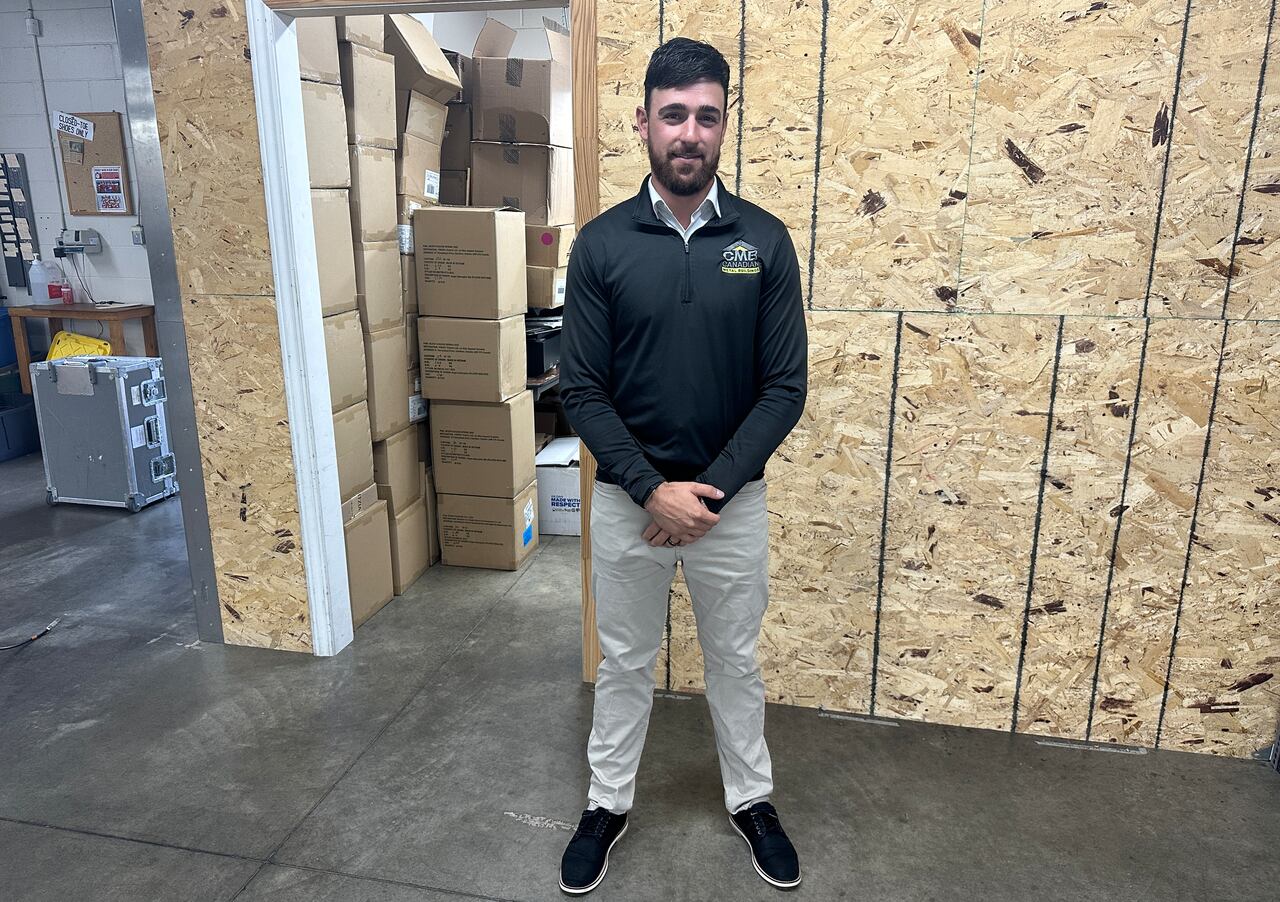
Lucas Bruzzese, CEO of Canadian Metal Buildings, expresses his excitement after being selected as one of the nine Hamilton businesses to receive over $12.5 million in federal assistance. (Jeffery Tram/CBC)
As part of the announcement on Monday, the federal government will invest half of a $400,000 project from Niko Apparel, a Canadian manufacturer of technical apparel, aimed at upgrading equipment and enhancing workforce skills.
Joe Camillo, president of Niko Apparel, remarked that the funding will enhance the company’s competitiveness both in Canada and internationally while continuing production in Hamilton.
“Without the ability to export and compete globally, we can’t offer the quality of life that our citizens deserve in this region,” he stated.
‘We Will Build’
Solomon emphasized that the federal government is endeavoring to assist businesses in navigating the uncertainty stemming from the trade conflict while still making investments.
“We are here to safeguard our country, our community, our democracy, our enterprises, our entrepreneurs, and our workforce,” he asserted.
He likened the trade situation to a hockey game, suggesting that while Canada may currently be in a “scrap” with the United States, they will eventually resume their partnership.
“In the meantime, we will not yield or break; we will build,” he affirmed.
According to him, the businesses receiving support are opting to invest despite the prevailing uncertainty.
“All of these companies are investing because the windshield is larger than the rearview mirror,” Solomon explained.
The federal government recently announced a $7.5 billion initiative comprising new and enhanced measures aimed at Canadian workers and businesses, in addition to nearly $25 billion in support introduced since the imposition of U.S. tariffs.
The government plans to allocate an extra $1.5 billion to the Regional Tariff Response Initiative starting in September, with liquidity support available up to $2 million.
“This is not a defensive move,” Solomon clarified. “This is about absorbing, constructing, and growing.”
For Bruzzese, the aim is to navigate through the current unpredictability and emerge with a more robust Canadian enterprise.
“There are abundant opportunities available here in Canada,” he noted. “That is what we are dedicated to servicing and enhancing our capacity.”
Solomon Visits Roustan Hockey in Brantford, Ont.

An animated gif displays scenes including W. Graeme Roustan, owner and CEO of Roustan Hockey, left, alongside AI and Digital Innovation Minister Evan Solomon, and employees at Roustan Hockey in Brantford, Ont., on August 31. (Alex Lupul/CBC)
On the same day, Solomon visited the manufacturing plant of Roustan Hockey in Brantford, Ontario. Roustan produces traditional wooden hockey sticks and has a legacy that traces back to the 1800s. The company has endured decades of global trade changes, maintaining its status as the last commercial manufacturer of classic wooden sticks in North America.
In a statement released Monday, Roustan expressed gratitude for the support received from Canadians and the interest shown by the federal government, stating, “as the stewards of the only commercial hockey stick factory in Canada, we are very appreciative.”
The statement further encouraged Canadians to purchase Made in Canada products, asserting that every purchase supports Canadian workers, communities, and the future of hockey in Canada.

