

This Friday, over 10,000 fans will gather at a quay in Bari, a port city in southern Italy, to commemorate a milestone that once seemed as improbable as an Italian drizzling ketchup on spaghetti: 1,413.
This figure represents the number of consecutive days that Prime Minister Giorgia Meloni’s administration will have been in power as of September 4, surpassing the previous record held by Silvio Berlusconi’s second government and establishing itself as the longest-serving government in Italy’s postwar history.
The event will be highlighted by a rally hosted by Meloni’s Brothers of Italy party at the Bari port, where the prime minister will be accompanied by ministers, lawmakers, and supporters in what is being promoted as a celebration of the government’s historic duration.
For a nation that has seen 68 governments come and go in the 80 years following World War II, this record may speak more about Meloni’s character than about Italy itself.
As Italy’s first female leader, Meloni built her public image around themes of struggle and resilience.
Growing up in Rome’s working-class Garbatella neighborhood, primarily raised by her mother after her father left, the 49-year-old Meloni entered the political arena in the 1990s through the youth branch of the post-fascist Italian Social Movement.
Identifying as an “underdog,” she emphasizes resistance as a key motivator, recently stating to the New York Times, “a ‘No’ is one of the things that most mobilizes me.”
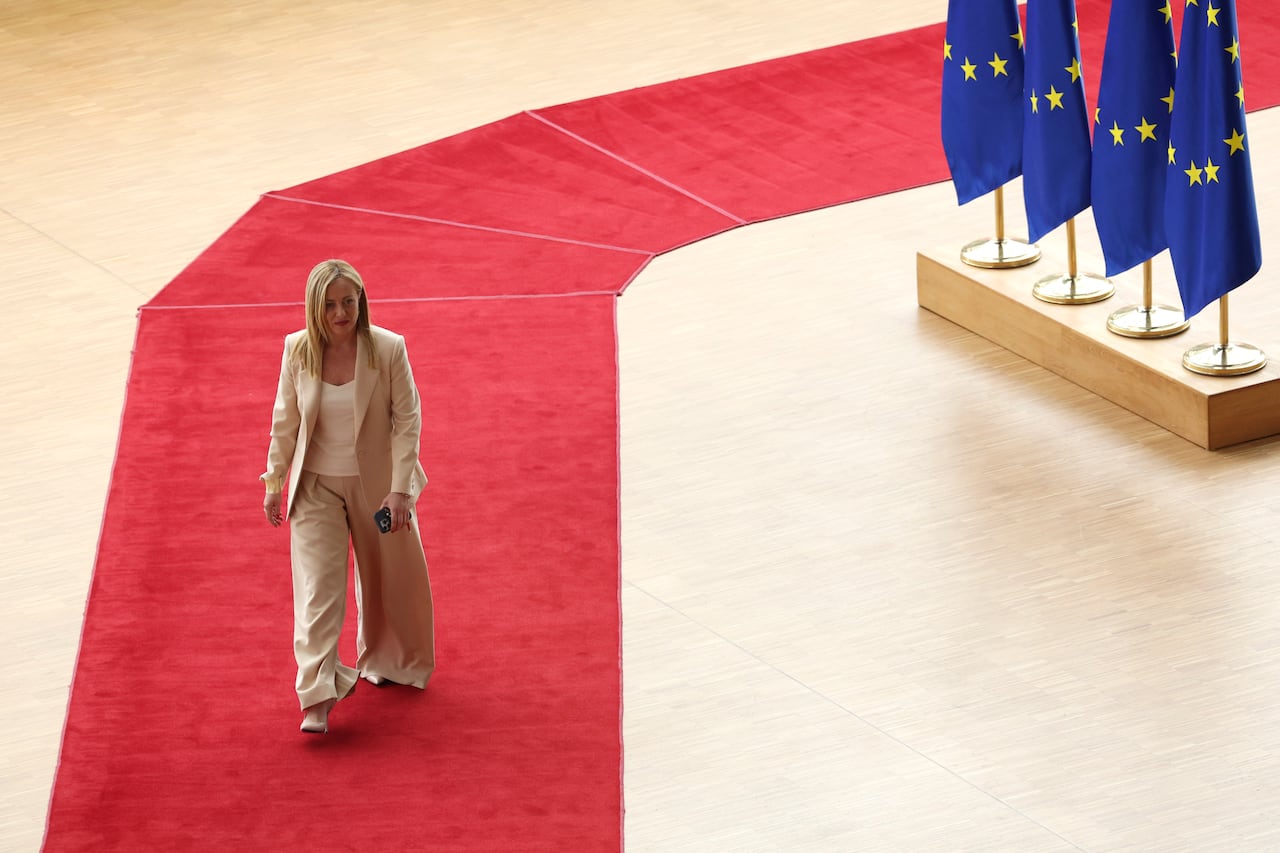
Meloni arrives for an EU summit at the European Council building in Brussels on June 29, 2023. (Geert Vanden Wijngaert/The Associated Press)
Her approach to political communication is equally personal. The slogan that propelled her to fame — “I am Giorgia, I am a woman, I am a mother, I am Italian, I am Christian” — became popular enough to be remixed into a dance track.
Governing by coalition
However, for someone who has crafted her image around confrontation, it is her cautiousness, rather than aggression, that has defined her leadership style.
While Italian politics is littered with the remains of male leaders who have stumbled due to overreach, Meloni’s strength lies in her ability to recognize when not to overextend herself.
She exhibited this patience even before assuming office. When nearly all significant parties joined Mario Draghi’s broad coalition government in 2021, Meloni opted to keep her smaller, fringe Brothers of Italy party out of the alliance.
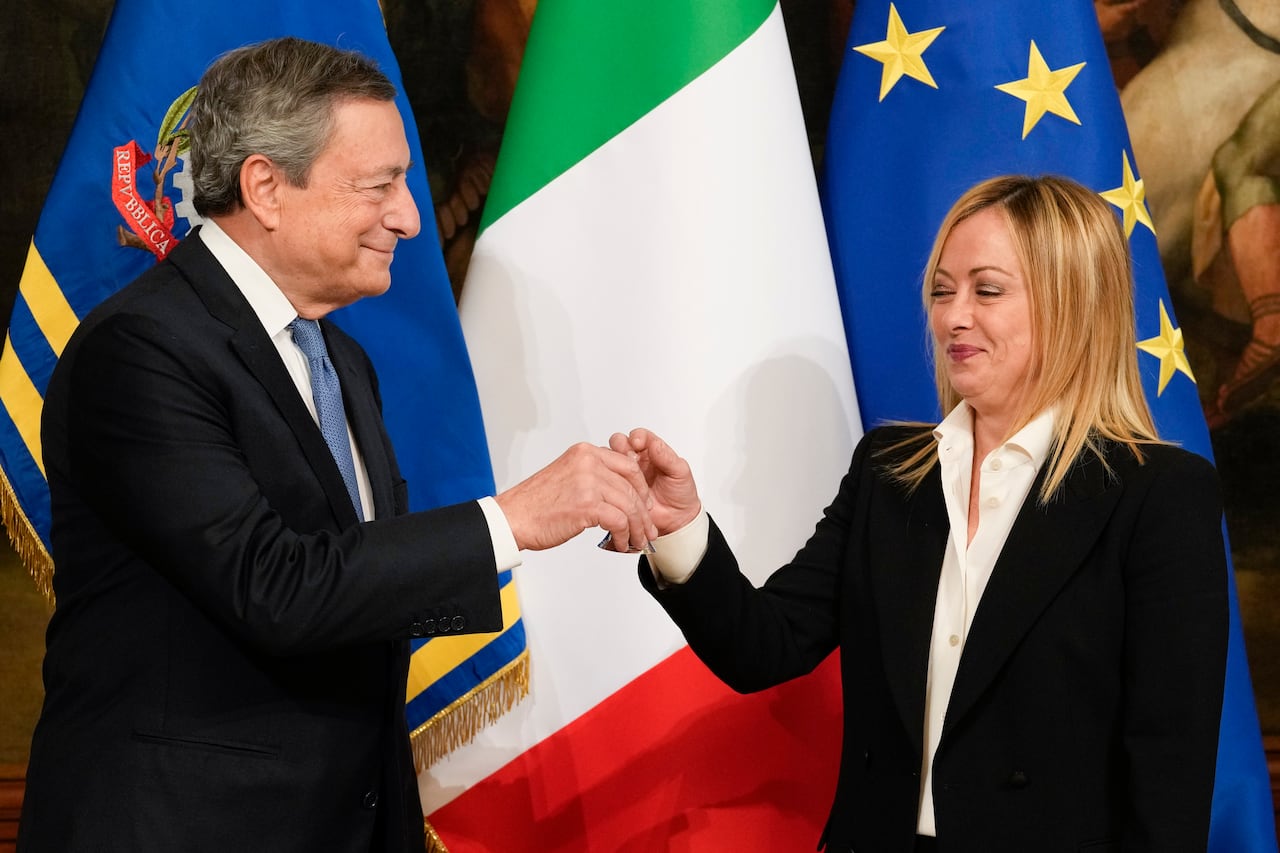
Outgoing Italian Premier Mario Draghi, left, hands over the cabinet minister bell to Meloni during a ceremony in Rome on Oct. 23, 2022. (Andrew Medichini/The Associated Press)
Following the collapse of Draghi’s government in 2022, Meloni ascended to power, leading a three-party right-wing coalition that granted her a solid majority in parliament. The politician who once criticized Brussels has since largely adhered to the EU’s fiscal policies, maintained a staunch pro-Ukraine stance, and has remained quiet on previous discussions about challenging the euro.
She has also succeeded in maintaining a sometimes-contentious alliance with Matteo Salvini’s anti-immigration, pro-Russia League and Antonio Tajani’s center-right Forza Italia.
This blend of a fiery political persona and practical governance has contributed to her defying expectations.
Lorenzo Pregliasco, a leading pollster with YouTrend, describes Meloni’s longevity as “highly unusual.” Currently, Brothers of Italy is polling slightly above its 2022 election performance, which is noteworthy in a country where ruling parties usually start to lose support shortly after taking office.
However, Pregliasco cautions against interpreting this as overwhelming affection for the party’s leader.
“Meloni’s favorable polling does not indicate a profound, enthusiastic backing for her government,” he stated. “The critical factor here is how credible Meloni is perceived, as opposed to the alternatives.”
-
Just call her Giorgia: Italian PM Meloni’s transformation from the margins to power broker
-
Italy’s far-right threat has vanished, but a familiar dread returns as Meloni settles into office
The alternative — an opposition led by the Democratic Party and the populist Five Star Movement, both of which have shifted to the left — remains fragmented. Meanwhile, Meloni continues to hold a dominant position within her coalition, with Brothers of Italy polling significantly ahead of both the League and Forza Italia.
Her governing approach also includes an understanding of when rhetoric and policy might subtly diverge.
Migration illustrates this point. Meloni campaigned vigorously to halt migrant arrivals by sea to Italy — figures that have significantly decreased from their peak in 2023 — and initiated controversial offshore processing centers for migrants in Albania.
At the same time, her administration has sanctioned nearly half a million legal entries for non-EU workers between 2026 and 2028 in response to acute labor shortages caused by Italy’s aging population.
This same practical compromise is evident in her foreign policy as well.
The sole EU leader present at Donald Trump’s inauguration, Meloni was often portrayed as Europe’s natural link to the U.S. president. However, fostering that connection to Trump turned out to be as challenging as constructing a bridge across an Italian fault line: the relationship strained over the U.S.-Israeli conflict involving Iran and Trump’s criticism of Pope Leo.
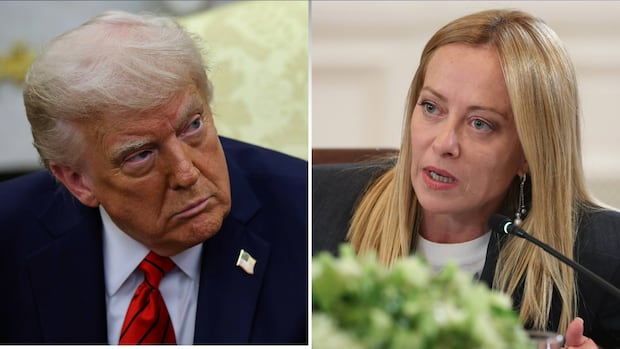
Italian Prime Minister Giorgia Meloni fired back at U.S. President Donald Trump after he suggested she was trying to repair ties with Washington to boost her approval ratings. The exchange comes days after Trump claimed Meloni had ‘begged’ him for a photo at the G7 summit in France.
Her capacity to adjust without seeming to forsake her political identity contributes to the credibility voters continue to afford her, according to Pregliasco.
She continues to advocate for themes of nation, family, motherhood, and traditional values. Meloni has tightened regulations regarding same-sex parenthood and has critiqued feminists for emphasizing gender quotas and symbolic language battles, asserting that genuine equality means a woman should have the freedom to become prime minister in the first place.
Such rhetoric resonates strongly with a conservative voter base in one of the world’s oldest nations.
-
Italy’s PM Meloni fires back, tells Trump to worry about his own popularity
-
Analysis
Is it normal for the U.S. president to spar with the Pope?
Stability vs. growth
However, economist Veronica De Romanis from Rome’s Luiss University argues that the very caution that has safeguarded Meloni politically has also hindered significant structural reform in a country where the debt-to-GDP ratio ranks second only to Greece in the EU.
“Stability is a means,” she stated. “The objective is growth, economic advancement, and that has not been achieved.”
De Romanis acknowledges the fiscal discipline of the Meloni administration but contends that its leader has not capitalized on four remarkably stable years to address issues like weak productivity, low education funding, or the precarious position of women and youth in Italy’s labor market.

In a country where female employment hovers around 53 per cent, Meloni has pledged to boost that figure to both support growth and counter Italy’s demographic decline. (Remo Casilli/Reuters)
Increased female employment and higher birth rates are positively correlated across Europe, she noted, challenging the idea that getting more women into the workforce worsens Italy’s demographic crisis.
“We cannot afford to have one out of two women at home,” she asserted.
Pressure from the right
As elections draw near next year, a stagnant status quo poses no greater threat to Meloni than the realization of what it means to be in the crosshairs. The outsider, who built her career by criticizing the political establishment, now faces challenges from within her own right flank.
Former general Roberto Vannacci, positioning himself to Meloni’s right after splitting from Salvini’s League, is actively attempting to outmaneuver her on issues of immigration, security, and social policies, including his opposition to 2SLGBTQ+ rights and abortion.
Vannacci presents Meloni with something she has long sidestepped, according to Pregliasco: “An opposition from the right that can effectively communicate with her voter base.”
After an unprecedented 1,413 days in office, Meloni has shown a rare instinct in contemporary Italian politics: understanding when to engage in conflict, when to retreat, and when to endure.
Yet, whether Italians will trust Meloni to convert political stability into meaningful change is a question they may decide at the upcoming polls next year.

