

A recent peer-reviewed study by the Pacific Salmon Foundation, published in the journal Aquaculture, reveals that viral heart disease is more prevalent in open-net salmon farms in British Columbia than earlier findings indicated.
The research identified heart and skeletal muscle inflammation (HSMI) in five out of seven open-net pen salmon farms located in the Broughton Archipelago, a series of islands situated east of Port McNeill on Vancouver Island.
Researchers also noted that the virus responsible for the disease, piscine orthoreovirus (PRV), has the potential to migrate into the surrounding waters, posing a risk of infection to wild fish.
“Our findings indicate that the prevalence of the disease is significantly higher than previously believed,” stated lead researcher Emiliano Di Cicco.
The use of open-net fish farms along the coast of B.C. has been a contentious issue, particularly concerning the potential for disease transmission from farmed fish to wild salmon in nearby waters.
In a study published by Di Cicco and his team in 2017, they found evidence of the disease in one out of four farms examined. However, Di Cicco noted they suspected it wasn’t just an isolated case.
“Now we have proof that our earlier assumption was incorrect,” he remarked.
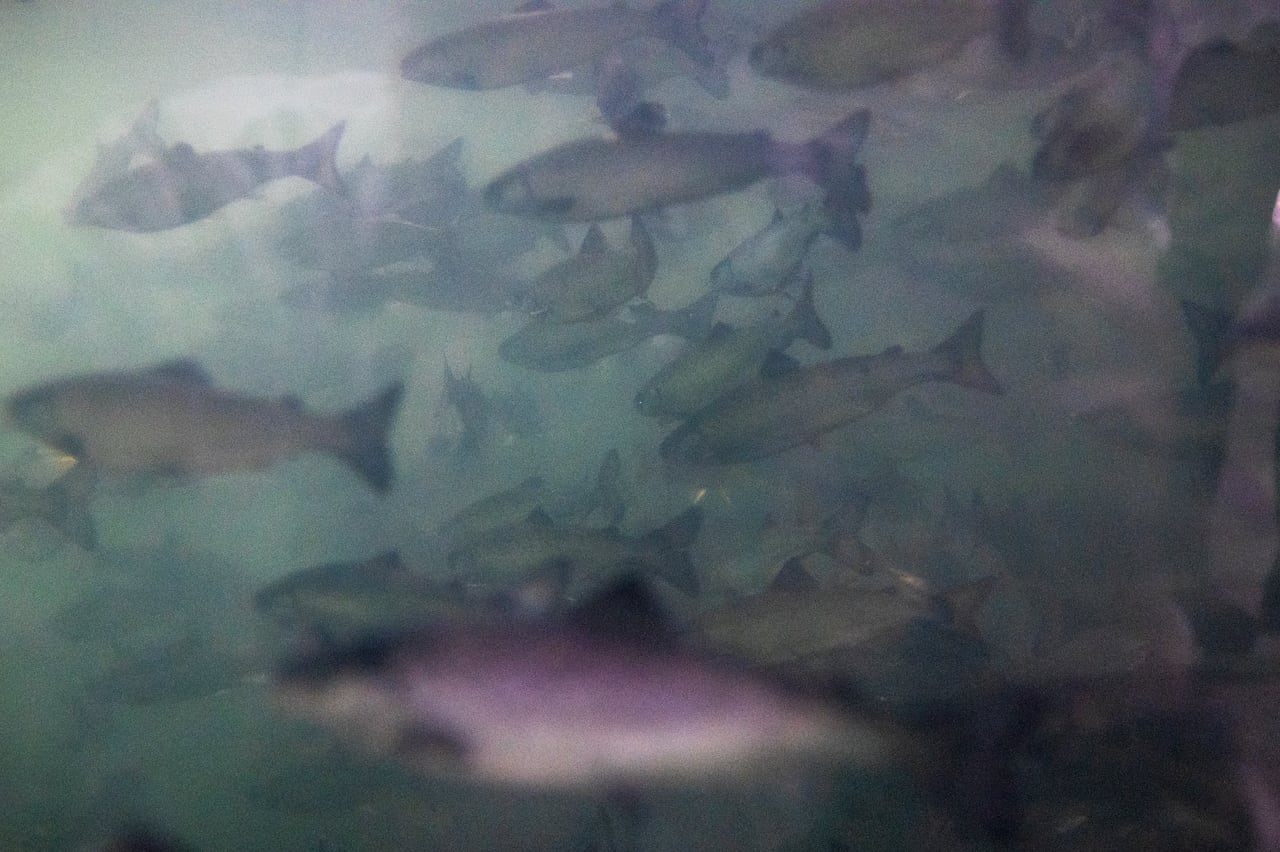
Hundreds of thousands of Atlantic salmon school together in a tank at Mowi’s Big Tree Creek salmon hatchery near Campbell River. (Kieran Oudshoorn/CBC)
DFO Evaluates Study Results
Nearly seven percent of the 749 salmon examined by three independent pathologists across the studied farms exhibited signs of HSMI.
Just a decade ago, the role of PRV in the development of HSMI was unclear, partly because infected fish could carry the virus without showing symptoms. However, in 2017, experiments conducted by Norwegian scientists confirmed the association, according to Di Cicco.
The study indicates that Pacific salmon infected with PRV may experience anemia, inflamed hearts, impaired liver and kidney function, and jaundice.
Despite this, Di Cicco pointed out that the Department of Fisheries and Oceans (DFO) in B.C. currently categorizes the virus as non-pathogenic, meaning it is not recognized as a disease-causing agent. He urges the federal government to reconsider this classification.
Moreover, he advocates for aligning the disease diagnosis criteria with those used in other nations. He argues that DFO employs different benchmarks for identifying HSMI, focusing on visible symptoms or significant mortality increases within fish populations.
Di Cicco maintains that globally, HSMI is acknowledged as a chronic, low-level illness.
“If you only expect to diagnose the disease when all these specific conditions are met, you are likely to overlook it,” Di Cicco explained.
-
Federal Court of Appeal maintains ban on salmon farms in B.C.’s Discovery Islands
-
New research indicates higher pathogen levels near B.C. open-net salmon farms
In a statement, the DFO confirmed it would assess the study and factor its conclusions into future initiatives.
“Identifying a virus or disease in farmed fish does not inherently indicate an impact on or decline in wild salmon populations,” the department stated.
The DFO further noted that its diagnostic criteria for HSMI were developed in collaboration with leading scientific experts.
“In January 2020, veterinarians and pathologists from Canada and around the world established the current case definition of HSMI to ensure it is scientifically rigorous and meets the highest international standards.”
The B.C. Salmon Farmers Association has not yet responded to a request for comment. Previously, the industry group has referred to concerns regarding PRV as “fearmongering,” asserting that the virus is “a common, relatively harmless, and widely spread marine virus.”
Industry representatives have stated that salmon farming in B.C. creates well-paying, skilled employment opportunities and accounts for 95 percent of Canada’s salmon production.

Demonstrators protest outside the Department of Fisheries and Oceans office, advocating for the closure of fish farms in B.C. in downtown Vancouver in September 2020. (Ben Nelms/CBC)
Collaboration with Indigenous Nations
The recent research was conducted in collaboration with the Mamalilikulla, ʼNa̱mǥis, and Ḵwiḵwa̱sut’inux̱w Ha̱xwa’mis First Nations.
Rick Johnson, Chief of the Kwikwasut’inuxw Haxwa’mis First Nation, emphasized that salmon has always been vital to the coastal Indigenous communities in B.C., and now it is time for people to support salmon.
“We have always been aware of the issue,” he remarked.
“It’s a blessing to have scientific evidence confirm our beliefs.”
Don Svanik, the elected chief councillor of the Namgis First Nation, expressed that he has been advocating for the closure of open-net pen salmon farms for many years.
“We are salmon people… it is a fundamental part of our identity,” he stated.
“Our ancestors recognized its importance for the ecosystem and the environment. I think humanity has somewhat lost sight of that.”

