

Astronaut Joshua Kutryk from the Canadian Space Agency recently embarked on his six-month mission to the International Space Station (ISS), having launched 11 days ago.
During his initial Q&A session with journalists on Tuesday, he expressed that he is “having a blast” so far.
Kutryk mentioned that he is still acclimating to life in space, requiring him to re-learn basic skills such as sleeping (“What do you do with your neck when you’re sleeping? What do you do with your hands?”), eating, and using tools.
“It feels like being two or three years old again, learning the simplest tasks in life,” he reflected on the challenges of microgravity. “It can be quite frustrating, but when you take a moment to look out the window and chuckle at yourself, it becomes a lot of fun and incredibly rewarding, making me feel fortunate to be on this mission.”
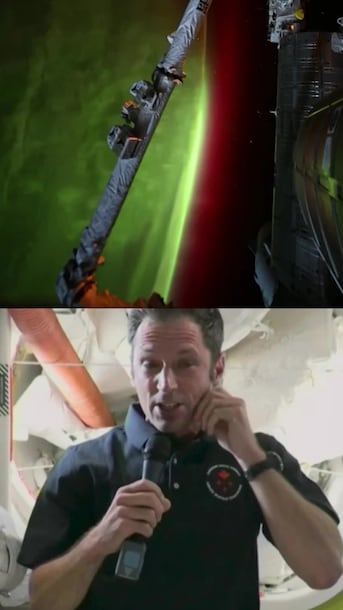
While answering reporters’ questions from the ISS, Canadian astronaut Joshua Kutryk shared the ‘exhilarating’ experience of launching into orbit and witnessing the northern lights from space. Currently, he is two weeks into a six-month mission as part of NASA’s SpaceX Crew-13, where he will conduct experiments and perform essential maintenance tasks.
However, it’s not just about enjoyment; he has also been diligently working.
Kutryk reported that he has already initiated several scientific experiments, including one focused on mental health and another tracking his vital signs.
‘Canada’s strong legacy in space’
This marks Kutryk’s inaugural journey into space, following just six months after fellow Canadian astronaut Jeremy Hansen’s lunar orbit during the Artemis II mission.
He expressed his hope that Canadians view this mission as a pathway to innovation and a “brighter future.”
-
This medical device heading to space with Joshua Kutryk is also helping people here on Earth
-
Joshua Kutryk’s launch to the ISS is another example of the important role Canada plays in space exploration
“I hope people recognize this as a testament to what Canada is capable of,” he stated. “This is significant as it brings together industry, academia, and commercial entities from Canada, placing them at the forefront of spaceflight. That’s how innovation occurs and new technologies emerge.”
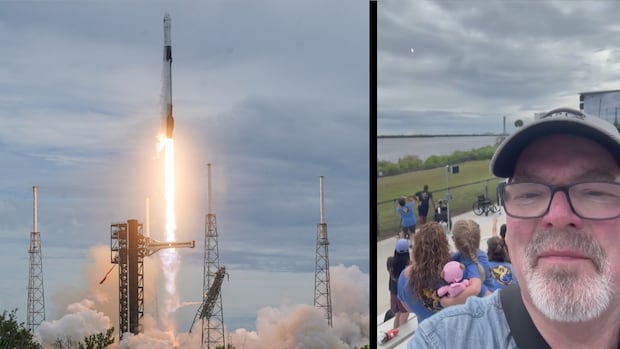
Ted Hupé shares with The National the moment he witnessed his former Grade 6 student, Canadian astronaut Joshua Kutryk, launch into space for the Crew-13 mission to the International Space Station, from Cocoa Beach, Florida.
Kutryk pointed out that during the Q&A session, he was flying over Vancouver and would soon cross over Quebec.
“I get to see the country quite a bit from up here,” he remarked.
He also mentioned witnessing a stunning display of the northern lights.
Additionally, he noted a weight loss of five pounds since arriving at the ISS, highlighting the importance of exercise and nutrition in space living.
Many of the experiments conducted on board focus on astronaut health.
One Canadian project set to conclude in the upcoming months is called T-Bone, which employs 3D technology to examine alterations in astronauts’ bone health. However, there are numerous other Canadian studies taking place on board.
Kutryk emphasized that Canada plays a crucial role in space exploration.
“I hope people understand the broader significance. It’s vital for Canada to be involved,” he explained. “We gain numerous benefits from these missions, and we aspire to uphold Canada’s strong legacy in space for the future.”

