

As layoffs continue at Ontario’s Workplace Safety and Insurance Board (WSIB), some employees who have been notified — along with their union — are expressing worries regarding the agency’s adoption of artificial intelligence (AI).
The Ontario Compensation Employees Union (OCEU), representing WSIB staff, revealed the job cuts earlier this month. A total of 566 individuals, comprising both unionized and non-unionized employees, were impacted, according to OCEU president Harry Goslin in an interview with CBC News last week.
Brittnee Gauthier, a case manager in Sudbury, was among those affected. Prior to the layoffs, she mentioned that WSIB had made a significant effort to roll out a new AI tool designed to summarize claims documents.
“It seems clear to me that the future for this organization is AI,” she remarked.
“While I believe AI can be beneficial,” she added, “we were all enthusiastic about the launch of this tool — until we learned it was rendering us redundant. My concern now is about who could be next.”
Union leader Goslin expressed that the OCEU is apprehensive about how WSIB will manage claims in the future, asserting that the layoffs appear to be linked to efforts to automate processes.
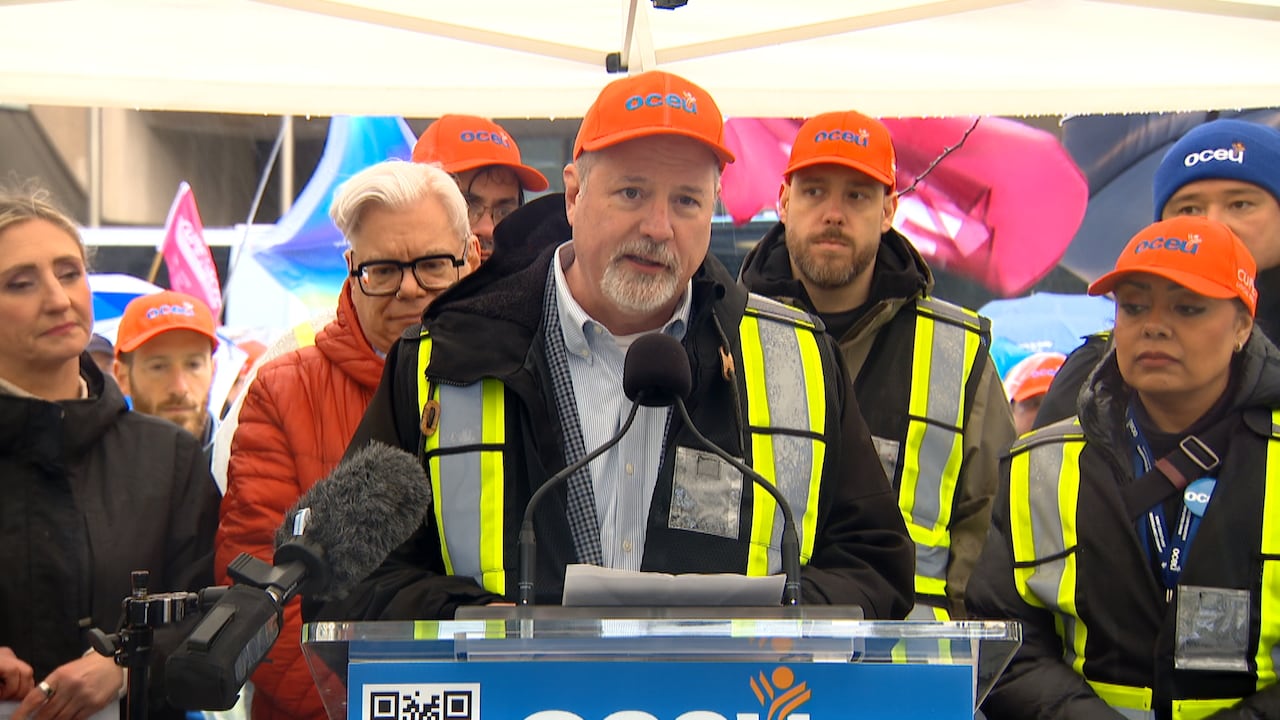
Harry Goslin, president of Ontario Compensation Employees Union, is seen in this file photo in Toronto. (Grant Linton/CBC)
When the layoffs were first disclosed, the WSIB described them as a “difficult business decision,” according to a statement made to CBC News.
The agency stated it is “constantly exploring methods to modernize our operations and provide optimal support for individuals while ensuring value for the premiums paid by Ontario businesses.”
Records from WSIB indicate that a contract valued at $7.3 million was awarded to Owl.co for a “claims summary tool subscription” back in February. In October, WSIB CEO Jeff Lang is set to present at a conference in Las Vegas alongside Owl.co CEO Sean Merat on how “WSIB is deploying AI at extraordinary scale.”
CBC News inquired if the introduction of AI tools was connected to the recent layoffs.
“For years, WSIB has utilized technology tools to minimize repetitive administrative tasks, allowing our team to concentrate more on assisting individuals in their recovery and return to work,” the agency replied.
“The claim summary tool, for instance, organizes information and documents, enabling team members to comprehend a claim more swiftly.”
‘Over 200 claims on my desk’
Laid-off employees reported that they received notifications during a brief group call attended by hundreds of others, leaving them with numerous questions and minimal answers.
Gauthier described the news as “devastating,” especially after leaving a decade-long career to join WSIB, but she believes “injured workers will face the greatest impact from this.”
She added: “Immediately, my thoughts went to my claims: I currently have over 200 claims on my desk.”
Now, Gauthier is hurrying to process these claims, stating, “because individuals will just start falling through the cracks.”

Brittnee Gauthier from Sudbury was among those laid off by WSIB in August. (Submitted by Brittnee Gauthier)
When asked about the implications of these changes for injured workers, Goslin indicated that legislation mandates that decisions should be evaluated on a case-by-case basis.
“AI is only as effective as its programming and the safeguards you implement,” he remarked, voicing concerns that services provided to claimants may decline.
The WSIB told CBC that it “remains dedicated to assisting individuals after a workplace injury or illness across Ontario. The methods by which people access our services have not been altered.”
‘Training the AI to take over our own jobs’
Sanjeev Kapoor is a customer service representative at WSIB in Sudbury who was part of the layoffs. His wife, Alyson Love-Kapoor, shared that their son’s first question was: “Are we going to lose our house?”
“You can’t [respond to questions like that],” Kapoor stated. “He prefers we not discuss it, as it makes him upset.”

Sanjeev Kapoor, pictured with his wife Alyson Love-Kapoor and their son, is one of the employees laid off by WSIB in August. (Submitted by Sanjeev Kapoor)
Kapoor mentioned that WSIB has been “forcing [AI] onto employees” at work, and he and his wife “have a sense that this layoff situation is far from over.”
He noted that he and other employees were instructed to train an AI system, verifying its responses and ensuring it provided correct policy numbers and dates.
“We were effectively training the AI to replace our own positions,” Kapoor stated, adding that the AI frequently generated incorrect policy numbers. Other employees have also raised concerns about the reliability and accuracy of WSIB’s AI, Goslin informed CBC News.
WSIB has not provided on-the-record responses regarding the precision of its AI tools or whether there are plans to utilize different AI programs.
The union has grievances regarding “the lack of transparency concerning technological changes that are not being communicated,” according to Goslin, who added that freedom of information requests have also been submitted.
Although WSIB is funded by individual companies rather than tax revenue, it is classified as a provincial Crown corporation, which reports to — yet operates at an “arm’s length” from — Ontario’s Ministry of Labour, Training and Skills Development.

