

For over five decades, the concept of “leap seconds” has been utilized by humanity to synchronize clocks with the Earth’s rotation.
On Thursday, a global timekeeping organization in France made the decision to eliminate leap seconds, allowing clocks to drift until they are misaligned by a whole hour, a process that could span centuries or even longer.
The atomic time we depend on for daily tracking — established in the 1950s and gauged by observing the natural oscillations of atoms — is slightly misaligned with solar time, which is determined by the sun’s position in the sky relative to a specific spot on Earth, due to the gradual slowdown in the planet’s rotation.
Leap seconds were first introduced in 1972 to address this difference. According to Scott Beattie, head of the frequency and time team at the National Research Council of Canada’s Metrology Research Centre, an initial ten seconds were added.
Since then, the International Earth Rotation and Reference Systems Service has been tracking the disparity between atomic time and the solar day to ascertain when an additional second is required.
When the necessary threshold is met, the International Bureau of Weights and Measures adds an extra second at the end of either December or June. To date, leap seconds have been added 27 times, with the most recent occurrence in 2016.
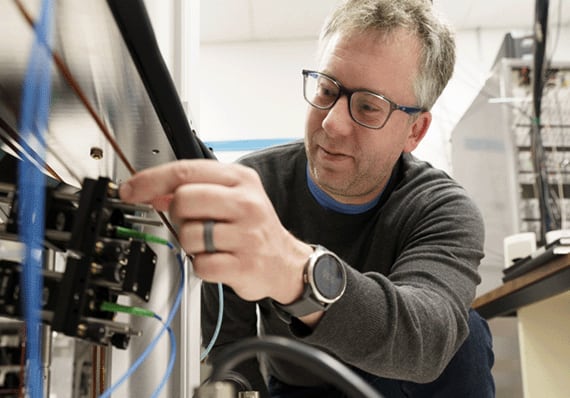
Scott Beattie, head of the frequency and time team at the National Research Council of Canada’s Metrology Research Centre, notes that managing leap seconds is becoming increasingly challenging as more systems depend on accurate timekeeping. (National Research Council Canada)
If these minor adjustments were not made, there would be no noticeable impact in our lifetimes. However, Beattie warns that eventually, “you might experience the brightest part of the day at midnight and the darkest part of the day at noon.”
This concept mirrors leap years, in which an extra day is added to February every four years to maintain the alignment of the Gregorian calendar with the seasons, as the Earth’s orbit around the sun takes about 365¼ days.
Without leap years, our warmest months would eventually align with what we currently consider winter, while the cooler months would fall in summer, according to Beattie.
What’s the issue?
However, the time has arrived when leap seconds appear to be causing more complications than benefits.
Beattie stated, “The general consensus globally is that we aim to eliminate these sudden leap seconds.”
This is due to the fact that the minor adjustment can create significant challenges for technology and telecommunications firms, along with systems that depend on precise timekeeping.

Manitoba clocks won’t spring forward or fall back anymore, after the province announced it’s doing away with the twice-a-year time change. But some experts say choosing daylight time rather than standard time could cause health issues and will be more of a burden for school-aged teens.
Different companies have their own methods for managing leap seconds, including adjusting their clock rates to distribute the extra second across several hours or over an entire day.
Beattie notes that these discrepancies among various networks pose a risk for system failures.
For instance, the leap second was cited as a reason for the crashes of Reddit and LinkedIn in 2012, along with brief outages at Cloudflare in 2016.
Beattie remarked, “The demand for timing accuracy and network synchronization is continuously increasing. The risks are escalating in tandem because a single system’s improper implementation could trigger a cascading failure, resulting in substantial issues.”
Negative seconds?
There is another intriguing aspect to consider.
In recent years, the Earth’s rotation has actually quickened, leading to the potential necessity of a “negative leap second” — where a second would be subtracted — in the future.
In 2022, tech giant Meta indicated that a negative leap second could have a “devastating impact” on software, adding, “In any event, every leap second presents significant challenges for those managing hardware infrastructures.”
-
Parts of northwestern Ontario moving to permanent daylight saving time in November
-
Seasonal time changes in N.W.T. officially end as of Nov. 1
The solution, approved on Thursday by the International Bureau of Weights and Measures, is to allow those additional seconds to accumulate to 3,600 — a complete hour — before making clock adjustments, effectively delaying the issue for many generations. This change is set to commence in May 2027.
Not everyone is satisfied with this resolution.
Paul Delaney, a professor emeritus of physics and astronomy at York University, expressed his surprise at the proposal.
He remarked, “This poses a challenge for our increasingly computerized, AI-driven economy, which is evidently what we have. But then again, don’t we still employ computer programmers to handle such issues? A part of me feels as though we are giving up and saying, ‘Oh, it’s too tough to tackle, and really, it is just a second.’
‘Not a flawless system’
Samantha Lawler, an associate professor of astronomy at the University of Regina, noted that various factors influence the speed of the Earth’s rotation, which has generally slowed down over time, partly due to the moon’s gravitational effects on Earth’s tides.
However, intricate elements, including climate change and glacial melting, can alter this trend.
-
This is how fast Swiss glaciers, the ‘water tower of Europe,’ are melting away
-
Climate change past the point of no return, UN says, as worst impacts are now unavoidable
She emphasized that there is no perfect solution for our clocks to accommodate these variations and that “we’ll be fine” without leap seconds.
“This is a genuine human dilemma that we’ve grappled with forever, as long as we’ve observed the stars moving across the sky and recorded the sun’s rising and setting, striving to establish the right patterns,” Lawler stated.
“It will always have some level of inaccuracy, and I believe we need to accept that.”

