

The Alberta government has rescinded habitat protections for one of Canada’s most at-risk species.
In July, amendments to the Public Lands Act allowed the province to withdraw protections for greater sage grouse within designated recovery and protection zones. That same month, Thor Resources, a helium extraction company, received new approval for operations in an area designated as greater sage grouse habitat.
Both the Alberta and federal governments classify the greater sage grouse as an endangered species. Current estimates indicate that fewer than 100 individuals remain in Alberta, with the population confined to the province’s southeastern region.
The greater sage grouse suffered a 98 percent decline in population in Alberta between 1968 and 2012, primarily due to habitat destruction and industrial activities. The species now occupies merely about seven percent of its historic range.
Mark Boyce, an ecology professor at the University of Alberta who has focused on greater sage grouse conservation since 1977, warns that the removal of provincial protections endangers the remaining Alberta population, potentially leading to local extinction.
“The province is indifferent,” Boyce stated. “We are on the brink of losing the most endangered vertebrate species in Canada because of this decision.”
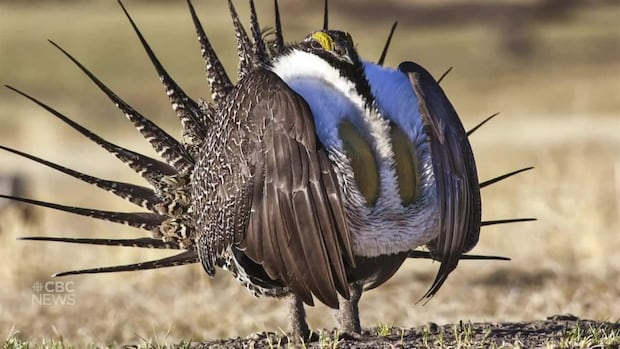
An iconic bird known for its unique mating ritual is at risk of disappearing from Western Canada. Once numbering in the thousands, fewer than 100 of the round-bodied birds remain in Alberta and Saskatchewan as their habitat shrinks
Boyce emphasized that sage grouse are particularly sensitive to development, often vacating their habitats in response to noise and traffic. Additionally, human structures create unnatural vantage points for predators such as eagles and owls, which threaten the endangered birds.
“It’s typical for Alberta to favor industrial growth over conservation,” Boyce commented.
“I believe the birds are doomed,” he continued. “I fear we will lose them entirely.”
Province’s plan ‘balances conservation outcomes with the needs of a changing province and economy’
In a statement to CBC News, Andrew Livingstone, communications director for Alberta Environment and Protected Areas, noted that the modifications aimed “to simplify regulatory requirements in sage grouse habitats and to offer greater flexibility and clarity for stakeholders operating in southeastern Alberta.”
“Alberta remains committed to a sage grouse recovery program designed to deliver an effective solution that aligns conservation goals with the requirements of a changing province and economy,” he added.
Livingstone mentioned that the province is enhancing recovery efforts, which include brood and nest augmentation initiatives, habitat restoration, predator management, stewardship partnerships, and improved monitoring.
“Alberta will continue to collaborate with industry and local stakeholders to promote responsible resource development while also facilitating the recovery of this endangered species,” he stated.
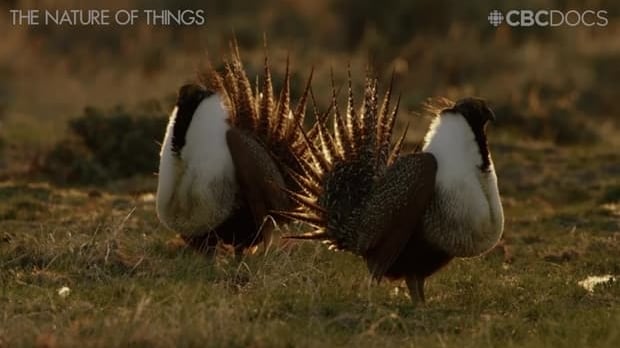
Each spring, endangered sage grouse males gather on ‘leks,’ performing grounds where they hope to dazzle females with their display and other-worldly mating call.
Joshua Killeen, conservation science and program manager for the southern Alberta chapter of the Canadian Parks and Wilderness Society, expresses concern that lifting provincial habitat protections jeopardizes years of efforts aimed at aiding the species’ recovery.
“Now, with these changes, it appears that all the progress made over the years is at risk. Without habitat protections, the species’ chances of survival are significantly diminished,” Killeen remarked.
“They are extremely vulnerable to being completely eliminated from Alberta and possibly from Canada,” he added.
- Grassland birds in crisis on the Canadian Prairies, conservationists warn
- ‘Conservation success story’: Endangered whooping crane makes rare appearance in central Alberta
Federal protections for approximately 25 percent of the greater sage grouse habitat in Alberta remain intact. The federal emergency order for greater sage grouse habitat, which was enacted in 2014, is the only active order of its kind in Alberta and one of only two ever issued.
“While that emergency order is still operational, the provincial regulations covered a much larger portion of the habitat,” Killeen explained. “Without those protections, we are left with only federal safeguards, which is a significant setback for the species.”
Helium industry pushed for provincial protections to be removed
Thor Resources, which received approval for operations in designated greater sage grouse habitat at the same time that the provincial protections were rescinded, included several sensitive wildlife surveys in its application, none of which addressed greater sage grouse.
Brent Jonah, CEO of Thor Resources, stated that when the company acquired its mineral rights over a decade ago, the provincial recovery area was not established, meaning they were initially outside the greater sage grouse territory.
Jonah mentioned that although the helium site will maintain structures below 1.2 meters in height and adhere to noise reduction measures as per previous protections, “there’s nothing specific I need to follow in these areas” regarding greater sage grouse anymore.
- Surging prices provide ‘adrenaline shot’ for Canadian helium industry
- Helium startups on the Prairies hope to keep domestic supplies afloat
Richard Dunn, executive director of the Helium Developers Association of Canada, noted that his organization had repeatedly requested the province to reconsider the habitat protections.
He argued that the provincial protections were excessively restrictive and that their removal is a necessary step toward “balancing environmental considerations, economic development, and social needs.”
“If you cannot access these areas for six to nine months of the year, the reality is that economic development is stifled,” he stated, referencing the former requirement to preserve sagebrush plants, native grasses, and native forbs within designated greater sage grouse habitat.

