

Since 1929, agriculture has been a part of Daniel Legault’s family heritage.
For three decades, he has managed Ferme Legault, a dairy and grain farm located in Rigaud, Quebec, together with his wife and son.
While he aspires to pass this family legacy to his three grandsons, a proposed high-speed rail initiative poses a threat to divide his property and disrupt operations.
“My father and I have dedicated our lives to establishing this business, yet we have no influence over what lies ahead,” he expressed.
The suggested train route aims to significantly reduce travel times between Toronto and Quebec City and could potentially cut straight through Legault’s land. He recalls receiving a flyer regarding the Alto project, followed by a notice seeking permission to survey his property, which he declined.
Legault argues that the planned train route would fragment his farm and impede his access to the primary road. He anticipates having to take lengthy detours numerous times daily to reach his fields, which would severely impact his operations.
“Logistically, it won’t be feasible,” he stated. “It will be impossible to care for all these animals.”
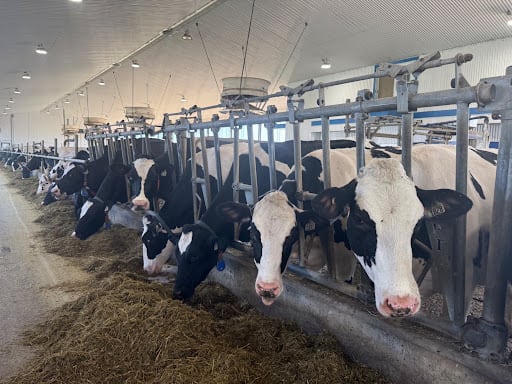
Ferme Legault is home to around 200 cows and encompasses 1,200 acres of farming land. (Chloë Ranaldi/CBC)
Outside of Legault’s farm, the Alto project is projected to affect approximately 1,700 properties, including at least 500 farms in the area between Ottawa and Montreal.
Legault mentions that a lack of information from the project’s developers has left his family’s future uncertain.
“[My son] no longer envisions the future as clearly as he once did,” Legault shared.
Disastrous for farming communities, says federation
Jérémie Letellier, president of the Fédération de l’UPA de la Montérégie, which is part of Quebec’s largest agricultural federation, claims the rail project would have catastrophic consequences for agricultural communities in both Ontario and Quebec.
“The impact on a single farm is catastrophic,” Letellier remarked. “Many farms might consider altering their practices or even ceasing operations entirely due to such a project.”
He indicates that everyone along the train’s proposed route from Rigaud to the North Shore is apprehensive.
-
Montreal-Ottawa high-speed rail line could cross 1,700 properties, Alto predicts
-
Front Burner
Could the Alto high speed rail plan be derailed?
Letellier emphasizes that the train line will bisect farmland, leaving no option for crossing over the tracks.
“Instead of needing to travel a few hundred meters, you may find yourself needing to go 15 to 20 kilometers. This alters everything in terms of cost and practicality,” he explained.

Jérémie Letellier serves as the president of the Fédération de l’UPA de la Montérégie. He argues that the high-speed rail line will devastate agricultural enterprises and create significant challenges for property owners. (Chloë Ranaldi/CBC)
Letellier is also criticizing Alto’s insufficient transparency and lack of engagement with his members in recent months, noting that there are many questions and concerns about their futures.
“We need to take a step back and thoroughly assess all alternative options,” he stated.
‘We want to do things right,’ Alto says
Caroline Des Rosiers, a representative for Alto, mentioned that a more refined route for the initial segment of the network between Ottawa and Montreal is anticipated later this fall.
“Although we are advancing the project quickly, it does not imply we will overlook essential steps,” she remarked.
“Our goal is to do things correctly.”
Des Rosiers stated that from the outset, Alto has pledged to minimize impacts on agricultural communities.
“This could involve, wherever possible, aligning with existing land boundaries or infrastructure to limit effects on properties as much as possible,” she noted.
Des Rosiers added that they intend to create overpasses and underpasses when feasible to avoid isolating certain areas.
“We understand that this is a significant concern for many people, and we are committed to preserving access,” she stated. However, it remains uncertain where these access points will be established and which zones will be affected.
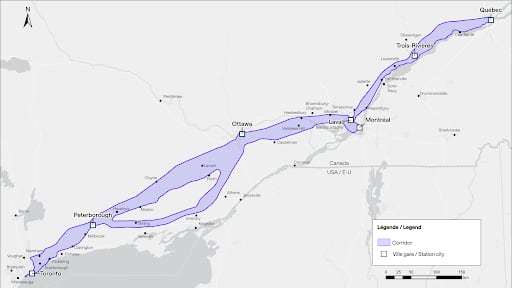
The currently proposed path for the Alto high-speed rail line connecting Toronto to Quebec City. Alto has indicated that a more specific corridor for the initial section of the network—a line between Ottawa and Montreal—is expected by the fall. (Courtesy of Alto)
Alto has also committed to ensuring that affected businesses receive fair compensation, considering the long-term impacts on agricultural operations, Des Rosiers mentioned.
The first round of public consultations has already taken place, with sessions conducted in various regions of Ontario and Quebec; however, none were held in the Vaudreuil-Soulanges area, where Legault’s farm is situated.
A second series of consultations is expected to occur this fall in Pointe-Fortune, following the presentation of a more detailed route. Alto has stated its intention to continue discussions with elected officials from various regions.
Nevertheless, these developments offer little reassurance to the Legault family, whose farming lifestyle has persisted for nearly a century.
“It’s disheartening to see our situation. Our plans have ground to a halt; our future is at a standstill,” Legault lamented.

